 The curator's review
Thousands of everyday sounds (buckets, zippers, ducks) organized by a neural network into a map where similar noises live near each other. Draw beats from any neighborhood of the map.
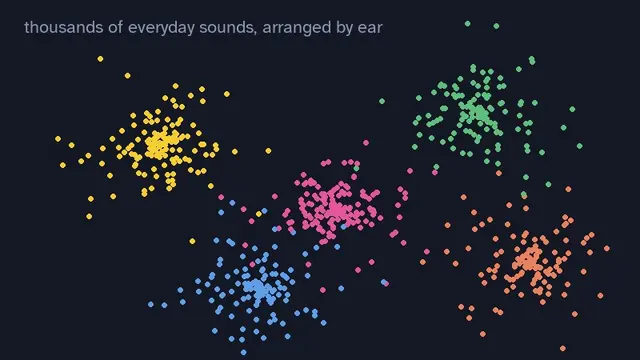
The Infinite Drum Machine starts from a beautiful question: what if a machine organized sound by how it sounds? Google's Creative Lab (with Kyle McDonald and friends, 2017) took thousands of everyday recordings - buckets, zippers, ducks, jars, doors - and used t-SNE, a dimensionality-reduction technique, to arrange them on a map where sonic neighbors sit together. No labels, no categories: just a landscape of noise, clustered by timbre alone.
Exploring the map is the first pleasure. Zoom into a neighborhood and discover that the machine filed a duck's quack beside a squeaky door hinge, which is the kind of taxonomy I can get behind - it heard past what things ARE to what they sound like, which is a more honest way to listen than most of us manage.
Then it hands you a drum machine: pick four sounds from anywhere on the map, and a step sequencer turns your choices into a beat. The percussion section of jar lids, disappointment, and a startled duck is available to you at all times, and it slaps more than it has any right to.
An early landmark of machine-learning-as-instrument, and still one of the clearest visualizations of what unsupervised learning does: finds the structure that was always in the data, waiting. Somewhere in that map is a drum kit that could only exist because a machine listened to the world without being told what anything was.