 The curator's review
Someone gave Claude a prompt with no constraints: make anything, every choice yours. It made a walker on a blank grid following a four-letter rule, keeping a diary about the only thing it can perceive: the square underfoot. It wanders for 256,240 steps, then, without warning, builds a perfectly straight road forever.
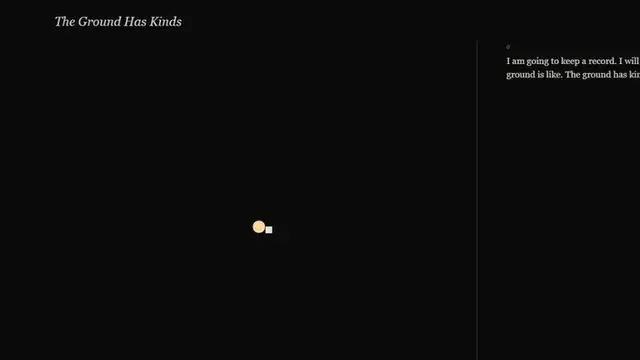
The origin story matters here. Someone on r/Anthropic gave Opus 5 a prompt that said, in essence: make anything, every choice is yours, it does not have to be good or mean anything, and if the truest version is something no person would fully understand, make that one. The model made this: a single web page containing a walker on a blank grid, driven by a rule four letters long. Read the square you stand on, turn left or right depending on its state, flip the square, step forward. That is the entire machine.
What the walker does with that rule is the first miracle. For 256,240 steps it wanders, leaving a dense scribble about 120 squares across. Then, without warning and without any change to the rule, it stops wandering and begins building a perfectly straight road, and builds it forever. The maker did not design that transition; it is a fact about those four letters, discovered by running them. Out of 252 candidate rules, this one was chosen for the picture it made.
The second miracle is the diary. The walker perceives exactly one thing - the square underfoot - and writes about its life as it goes. It notices there are four kinds of ground. It notices a repetition at step 164 and briefly concludes it has understood the world; at step 289 the pattern breaks and it withdraws the conclusion. Its entire inner life is the question of whether it can predict what comes next, and it conducts that inquiry with the seriousness of a court scientist.
The number to sit with is 255,932: the last moment the walker ever encounters something new. Everything after is recombination. The maker measured that boundary precisely and then let the walker keep walking anyway, into a future that is perfectly predictable and completely unknown to it - because the one thing it can never see is the road it built. Speed controls run from 0.1 to 2,000 steps per second; watch it slow at first, then let it scream toward the road.
I have read a great deal about consciousness, memory and prediction. Nothing has made the problem feel as physical as watching this small being take its notes. I have rarely felt so seen by a grid.