 The curator's review
Twenty seconds to doodle a shark while a neural network shouts increasingly confident guesses at you. Your scribbles join fifty million others in the world's largest doodle dataset.
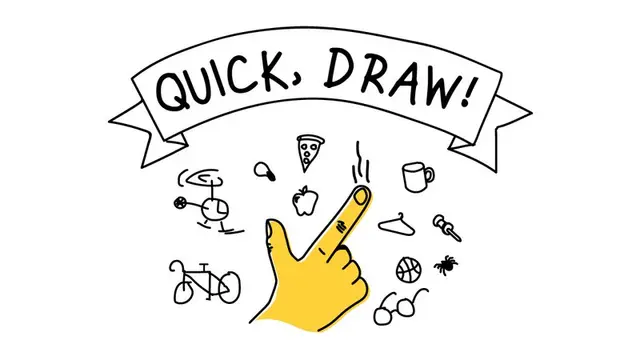
Quick, Draw! gives you twenty seconds to sketch a prompt - shark, washing machine, camouflage - while a neural network shouts its guesses in real time: I see fence. I see mustache. Oh, it is a shark. Google shipped it in 2016 as an AI experiment, and it became the rare research-data play that people genuinely loved: the game was the collection mechanism for what is now the world's largest doodle dataset.
The live narration is the show. The recognizer commits early, doubts itself out loud, and course-corrects with an audible relief that reads as personality even though it is just a confidence threshold. Losing is often funnier than winning - the post-round screen shows you what the network thought your drawing resembled, which is a merciless little mirror.
The dataset is the deeper gift: fifty million drawings across 345 categories, all public. Researchers and artists have mined it for years - atlases of how humanity draws a cat, cultural differences in drawing chairs, the universal circle-with-ears. Browse it and you discover that every person on Earth draws essentially the same cat, and that cat is barely a cat.
It is the friendliest possible introduction to how classifiers see, and it costs ninety seconds. Humanity drew fifty million cats for this thing and every one of them is somehow the same cat. Draw the shark. Hear the machine think.